Application of DerivativeHard
Question
The function f(x) is
is
isOptions
A.increasing on (0, ∞)
B.decreasing on (0, ∞)
C.increasing on (0,π / e) , decreasing on (π / e, ∞)
D.decreasing on (0, π / e) increasing on (π / e, ∞)
Solution
Given, f(x)
f′(x)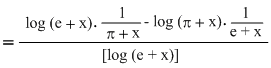 .....(i)
when x > 0,π + x > e + x
∴ log(π + x) > log(e + x)
and
On multiplying above equations, we get
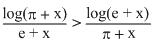 ......(i)
From Eqs. (i) and (ii),
f′(x) < 0
∴ f(x) is decreasing for x ∈ (0, ∞)
f′(x)
.....(i) when x > 0,π + x > e + x
∴ log(π + x) > log(e + x)
and
On multiplying above equations, we get
......(i) From Eqs. (i) and (ii),
f′(x) < 0
∴ f(x) is decreasing for x ∈ (0, ∞)
Create a free account to view solution
View Solution FreeMore Application of Derivative Questions
If = is a tangent to the curve x = Kt, y = , K > 0 then :...If the tangent to the curve f(x) = x2 at any point (c, f (c)) is parallel to line joining the points (a, f (a)) and (b,f...If the equation $a_n x^n + a_{n-1} x^{n-1} + \ldots + a_1 x = 0$, where $a_1 \neq 0$ and $n \geq 2$, has a positive root...The abscissa of the point on the curve ay2 = x3, the normal at which cuts off equal intercepts from the axes is-...On the ellipse 4x2 + 9y2 = 1, the point at which the tangents are parallel to the line 8x = 9y, are...