SHMEasy
Question
The potential energy of a particle of mass 1 kg in motion along the x-axis is given by :
U = 4(1 - cos2x)J, where x is in metres. The period of small oscillations (in sec) is :-
U = 4(1 - cos2x)J, where x is in metres. The period of small oscillations (in sec) is :-
Options
A.2π
B.π
C.π/2
D.√2π
Solution
F =  = - 8sin 2x
a = = -8sin 2x (∵ m = 1kg)
For small oscillations, sin2x = 2x
i.e., a = - 16x
Since a ∝ - x
The oscillations are SH in nature.
∴ T = 2π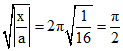 sec
sec
= - 8sin 2xa =
= -8sin 2x (∵ m = 1kg)For small oscillations, sin2x = 2x
i.e., a = - 16x
Since a ∝ - x
The oscillations are SH in nature.
∴ T = 2π
secCreate a free account to view solution
View Solution FreeMore SHM Questions
A particle performing SHM takes time equal to T (time period of SHM) in consecutive appearances at a particular point. T...A pendulum is hung from the roof of a sufficiently high building and is moving freely to and fro like a simple harmonic ...If A is the area of cross-section of a spring L is its length E is the Young′s modulus of the material of the spri...A particle is made to under go simple harmonic motion. Find its average acceleration in one time period....A simple harmonic oscillator has a period of 0.01 sec. and an amplitude of 0.2 m. The magnitude of the velocity in m sec...