Continuity and DifferentiabilityMedium
Question
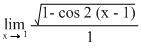
Options
A.exists and it equals √2
B.exists and it equals - √2
C.does not exist because x - 1 → 0
D.does not exist because left hand limit is not equal to right hand limit
Solution
LHL = 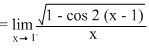
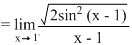
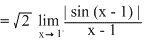
Put x = 1- h, h > 0
for x → 1+, h → 0
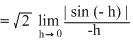 = √2
= √2 
 = - √2
Again, RHL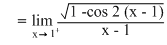
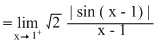
Put x = 1+ h, h > 0
for x → 1+, h → 0
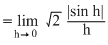
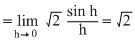
∴ LHL ≠ RHL
Hence, f(x) does not exist.
Put x = 1- h, h > 0
for x → 1+, h → 0
= √2 = - √2 Again, RHL
Put x = 1+ h, h > 0
for x → 1+, h → 0
∴ LHL ≠ RHL
Hence,
f(x) does not exist.Create a free account to view solution
View Solution FreeMore Continuity and Differentiability Questions
Function f(x) = |x| is-...If f(x) = where {x} denotes the fractional part function, then -...If y =, then dy/dx equals-...The set of all point where the function f(x) = 2x |x| is differentiable is -...The derivative of f(tanx) w.r.t. g(secx) at x = π/4 , where f′(1) = 2 and g′ (√2 ) = 4, is -...