FunctionHard
Question
If f :[1, ∞) → [2, ∞) is given by f(x) = x +  , then f-1(x) equals
, then f-1(x) equalsOptions
A.
B.
C.
D.
Solution
Let y = x + ⇒ y = 
⇒ xy = x2 + 1
⇒ x2 - xy + 1 = 0
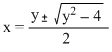
⇒
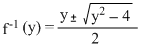
⇒
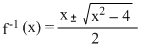
⇒
Since, the range of the inverse function is [1, ∞), then
we take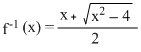
If we conside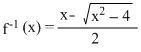 , then
f -1(x) > 1
This is possible only if (x - 2)2 > x2 - 4
⇒ x2 + 4 - 4x2 - 4
⇒ 8 > 4x
⇒ x < 2, where x > 2
Therefore, (a ) is the answer.
⇒ y = ⇒ xy = x2 + 1
⇒ x2 - xy + 1 = 0
⇒
⇒
⇒
Since, the range of the inverse function is [1, ∞), then
we take
If we conside
, then f -1(x) > 1
This is possible only if (x - 2)2 > x2 - 4
⇒ x2 + 4 - 4x2 - 4
⇒ 8 > 4x
⇒ x < 2, where x > 2
Therefore, (a ) is the answer.
Create a free account to view solution
View Solution FreeMore Function Questions
If f(x) = ax, then f(x + y) equals-...If f : R → R , f(x) = sin2 x + cos2 x , then f is -...Let f(x) = a x2 + b x + c, where a, b, c are rational and f : Z → Z, where Z is the set of integers. Then a + b is...If f(x) = cos (log x), then f(x) f(y) - 1/2 [f(x/y) + f(xy)] is equal to-...Maximum value of function f(x) = ∀ x ∈ R is...