FunctionHard
Question
If the function f : [1, ∞) → [1, ∞) is defined by f(x) = 2x(x - 1), the f -1(x)
Options
A.
B.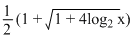
C.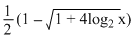
D.not definrd
Solution
Let y = 2x(x - 1), where y ≥ 1 as x ≥ 1,
Taking log2 on both sidws, we get
log2 y = log22x(x-1)
⇒ log2 y = x (x - 1)
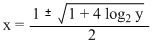
⇒ y2 - x - log2 y = 0
⇒
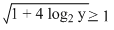
For y ≥ 1, log2 y ≥ 0 4 log2 y ≥ 0 ⇒ 1 + 4 log2 y ≥ 1
⇒
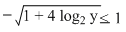
⇒
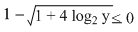
⇒
But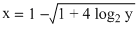 is not possible.
Therefore, we take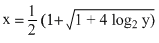
⇒ f -1(y) =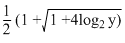
⇒ f -1(x) =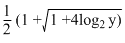
Taking log2 on both sidws, we get
log2 y = log22x(x-1)
⇒ log2 y = x (x - 1)
⇒ y2 - x - log2 y = 0
⇒
For y ≥ 1, log2 y ≥ 0 4 log2 y ≥ 0 ⇒ 1 + 4 log2 y ≥ 1
⇒
⇒
⇒
But
is not possible. Therefore, we take
⇒ f -1(y) =
⇒ f -1(x) =
Create a free account to view solution
View Solution FreeMore Function Questions
The range of the function f(x) = 2 + x − [x − 3] is-...The domain of the function f(x) = , is-...Domain of the function cos-1 (4x −1) is-...Let g(x) be a function defined on [-1,1] If the area of the equilateral triangle with two of its vertices at (0, 0) and ...If x = logabc, y = logbca, and z = logcab, then equals-...