Progression (Sequence and Series)Hard
Question
For a positive integer n let a(n) = 1 + 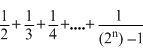 , then
, thenOptions
A.a(100) ≤ 100
B.a(100) > 100
C.a(200) ≤ 100
D.a(200) > 100
Solution
Given, a(n) = 1 +
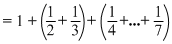
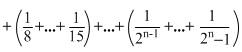
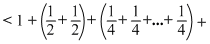
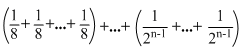
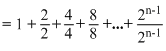
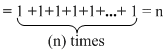
Thus, a (100) < 100,
Therefore, (a) is the answer
Again, a(n)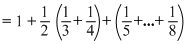
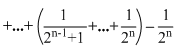
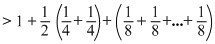
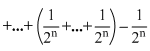
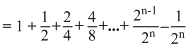
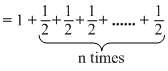
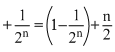
Therefore, a (200) >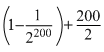 > 100
> 100
Therefore, (d) is also the answer.
Thus, a (100) < 100,
Therefore, (a) is the answer
Again, a(n)
Therefore, a (200) >
> 100 Therefore, (d) is also the answer.
Create a free account to view solution
View Solution FreeMore Progression (Sequence and Series) Questions
In a series of 2n observations, half of them equal a and remaining half equal -a. If the standard deviation of the obser...If a,b,c are in A.P., then are in-...$\frac{a_{1}}{1 + a_{1}} + \frac{a_{2}}{\left( 1 + a_{1} \right)\left( 1 + a_{2} \right)} + \frac{a_{3}}{\left( 1 + a_{1...The sum of the infinite series 12 + 22 x + 32 x2 + ..... is-...The sum $2 \cdot 3 + 3 \cdot 6 + 4 \cdot 11 + 5 \cdot 18 + \ldots. +$ upto $n$ terms is equal to...