Quadratic EquationHard
Question
The equation 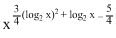 = √2 has
= √2 hasOptions
A.at least one real solution
B.exactly three real solution
C.exactly one irrational solution
D.complex roots
Solution
Given, = √2
⇒ (log2x)2 + log2 x = -
  = logx √2
⇒ (log2x)2 + log2 x =
⇒ 3(log2x)3 + 4(log2x)2 - 5(log2x) - 2 = 0
Put, log2x = y
∴ 3y3 + 4y2 - 5y - 2 = 0
⇒ ( y - 1)( y - 2)(3y - 1) = 0
⇒ x = 1, - 2, - 1/3
⇒ log2x = 1, - 2, - 1/3
⇒ x = 2,
= √2 ⇒
(log2x)2 + log2 x = - = logx √2⇒
(log2x)2 + log2 x = ⇒ 3(log2x)3 + 4(log2x)2 - 5(log2x) - 2 = 0
Put, log2x = y
∴ 3y3 + 4y2 - 5y - 2 = 0
⇒ ( y - 1)( y - 2)(3y - 1) = 0
⇒ x = 1, - 2, - 1/3
⇒ log2x = 1, - 2, - 1/3
⇒ x = 2,
Create a free account to view solution
View Solution FreeMore Quadratic Equation Questions
If x = then -...If a, b, c are all positive and in H.P., then the roots of ax2 + 2 bx + c = 0 are -...Let the inequalities $y( - 1) > - 4,y(1) < 0$ and $y(3) > 5$ are known to hold for $y = {ax}^{2} + bx + c$, the...If α and β are roots of 2x2 − 3x − 6 = 0, then the equation whose roots are α2 + 2 and β...The number of real roots of the eqaution |x2 + 4x + 3| + 2x + 5 = 0 is -...