Quadratic EquationHard
Question
If a, b and c are distinct positive numbers, then the expression (b + c - a)(c + a - b) (a + b - c) - abc is
Options
A.positive
B.negative
C.non-positive
D.non-negative
Solution
Since, as Am > GM
⇒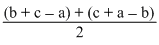 >((b + c - a)(c + a - b))1/2
⇒ c >((b + c - a)(c + a -b))1/2 .....(i)
Similarly b > ((a + b - c)(b + c - a))1/2 .....(ii)
and a > ((a + b - c)(c + a - b))1/2 .....(iii)
On multiplying Equs. (i),(ii) and (iii), we get
abc > (a + b - c)(b + c - a)(c + a - b)
Hence, (a + b - c)(b + c - a)(c + a - b) - abc <0
⇒
>((b + c - a)(c + a - b))1/2 ⇒ c >((b + c - a)(c + a -b))1/2 .....(i)
Similarly b > ((a + b - c)(b + c - a))1/2 .....(ii)
and a > ((a + b - c)(c + a - b))1/2 .....(iii)
On multiplying Equs. (i),(ii) and (iii), we get
abc > (a + b - c)(b + c - a)(c + a - b)
Hence, (a + b - c)(b + c - a)(c + a - b) - abc <0
Create a free account to view solution
View Solution FreeMore Quadratic Equation Questions
If the two equations x2 − cx + d = 0 and x2 − ax + b = 0 have one common root and the second has equal roots...If $a,b$ are the roots of the quadratic equation $x^{2} + \lambda x - \frac{1}{2\lambda^{2}} = 0$, where $\lambda$ is a ...If α ≠ β but α2 = 5α - 3 and β3 = 5β - 3 then the equation having α/β and ...If all the roots of the equation $x^{4} - 12x^{3} + ax^{2} + bx + 81 = 0$ where $a,b \in R$ are positive, then...If both the roots of the equations k (6x2 + 3) + rx + 2x2 − 1= 0 and 6k (2x2 + 1) + px + 4x2 − 2 = 0 are com...