Complex NumbersMedium
Question
If arg (z) < 0, then arg (- z) - arg (z) equals
Options
A.π
B.- π
C.- π/2
D.π/2
Solution
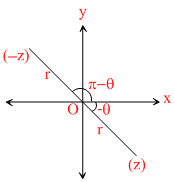
Since, arg (z) < 0
⇒ arg (z) = - θ
⇒ z = r cos (- θ) + i sin (- θ)
= r( cos θ - i sin θ)
And - z = - r [cos θ - i sin θ]
= r [cos(π - θ) + i sin (π - θ)
∴ arg (- z ) = π - θ
Thus arg (- z) - arg (z)
= π - θ - (- θ) = π
Alternate Solution
Reason : arg (- z) - arg z
= arg
 = arg (- 1) = π
and also arg z - arg (-z )
= arg
 arg (- 1) = π
Create a free account to view solution
View Solution FreeMore Complex Numbers Questions
If z1, z2 are complex numbers such that |z1 + z2 |2 = |z1 |2 + |z2 |2, then z1 / z2 is-...If z1, z2 and z3are complex number such that |z1| = |Z2| = |z3| = , then |z1 + z2 + z3| is...If 1, α1, α2, α3, α4 be the roots of x5 - 1 = 0, then find the value of (where ω is imaginary c...Let x and y be real number such that$50\left( \frac{2x}{1 + 3i} - \frac{y}{1 - 2i} \right) = 31 + 17i,\ \ i = \sqrt{- 1}...Modulus of a non-zero complex number z, satisfying z + = 0, || - 4zi = z2 is -...