Sound WavesEasy
Question
Y(x, t) = 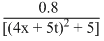 represents a moving pulse where x and y are in meter and t is in second. Then,
 Options
A.pulse is moving in positive x-direction
B.in 2 s it will travel a distance of 2.5 m
C.its maximum displacement is 0.16 m
D.its is a symmetric pulse
Solution
The shape of pulse at x = 0 and t = 0 would be as shown, in figure (a)
y(0, 0) = = 0.16
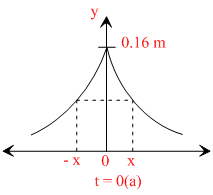
From the figure it is clear that ymax = 0.16 m.
Pulse will be symmetric (Symmetry is checked about ymax)if at t = 0
y(x) = y(-x)
From the given equation,
and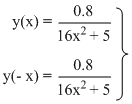 at t = 0
or y(x) = y(-x)
Therefore, pulse is symmetric.
Speed of pulse
At t = 1 s
and x = - 1.25 m
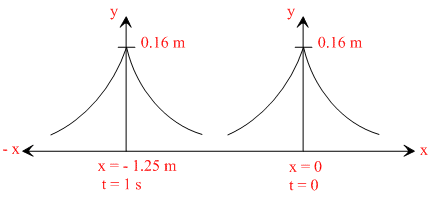
value of y is again 0.16 m, i.e., pulse has travelled a distance of 1.25 m in 1 s in negative x-direction or we can say that he speed of pulse is 1.25 m/s and it is travelling in negative x-direction. Therefore, it will travel a distance of 2.5 m in 2 s. The above statement can be better understood from figure (b).
y(0, 0) =
= 0.16 From the figure it is clear that ymax = 0.16 m.
Pulse will be symmetric (Symmetry is checked about ymax)if at t = 0
y(x) = y(-x)
From the given equation,
and
at t = 0or y(x) = y(-x)
Therefore, pulse is symmetric.
Speed of pulse
At t = 1 s
and x = - 1.25 m
value of y is again 0.16 m, i.e., pulse has travelled a distance of 1.25 m in 1 s in negative x-direction or we can say that he speed of pulse is 1.25 m/s and it is travelling in negative x-direction. Therefore, it will travel a distance of 2.5 m in 2 s. The above statement can be better understood from figure (b).
Create a free account to view solution
View Solution FreeMore Sound Waves Questions
If the density of oxygen is 16 time that of hydrogen. The ratio of their corresponding velocities of sound waves will be...The figure (i) shows the graphical representation of the air molecules in a tube of air (length = L) at atmospheric pres...In a resonance tube experiment, an 80 cm air column is in resonance with a turning fork in first overtone. Which equatio...A source of unknown frequency gives 4 beats/s, when sounded with a source of known frequency 250 Hz, The second harmonic...A sings with a frequency (n) and B sings with a frequency 1/8 that of A. If the energy remains the same and the amplitud...