Math miscellaneousEasy
Question
If a, b, c are non-zero real numbers and if the equations (a - 1)x = y + z, (b - 1)y = z + x, (c - 1) z = x + y has a non-trivial solution, then ab + bc + ca is equal to
Options
A.a + b + c
B.abc
C.1
D.None of these
Solution
From the system of equations
d1 = d2 = d3 = 0 ⇒ D1 = D2 = D3 = 0
D =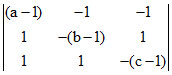 = 0
= 0
⇒ abc - ab - bc - ca = 0
⇒ ab + bc + ca = abc
d1 = d2 = d3 = 0 ⇒ D1 = D2 = D3 = 0
D =
= 0⇒ abc - ab - bc - ca = 0
⇒ ab + bc + ca = abc
Create a free account to view solution
View Solution FreeMore Math miscellaneous Questions
If f : R → R satisfies f(x + y) = f(x) + f(y), for all x, y ∈ R and f(1) = 7, then f(r) is...How many 7 digit numbers can be formed with the digits 1, 2, 3, 4, 3, 2, 1 so that the odd digits always occupy the odd ...Coefficient of x11 in the expansion of (1 + x2)4(1 + x3)7(1 + x4)12 is...From a point P(λ, λ, λ) perpendiculars PQ and PR are drawn respectively on the lines y = x, z = 1 and y =...For the equation = 1, , identify the correct option(s) -...