SHMEasy
Question
One end of a long metallic wire of length L is tied to the ceiling. The other end is tied to a massless spring constant k. A mass m hangs freely from the free end of the spring. The area of cross-section and the Young′s modulus of the wire are A and Y respectively. If the mass is slighly pulled down and released, it will oscillate with a time period T equal to
Options
A.2π(m/k)1/2
B.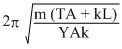
C.2π[(mYA / kL)1/2]
D.2π[(mY / YA)1/2]
Solution
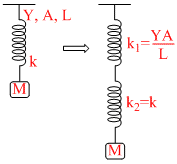
Keq =
 =
=  =
= 
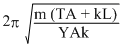
∴ T =
 =
= 
Note : Equivalent force constant for a wire is given by k =
 . Because in case of a wire, F =
  ᐃL and in case of spring F = k. ᐃL. Comparing these two, we kind k of wire =
Create a free account to view solution
View Solution FreeMore SHM Questions
If the distance between the centre of gravity and point of suspension of a compound pendulum is l and the radius of gyra...A pendulum is swinging in an elevator. Its perioed will be greasted when the elevator is...The total energy of a vibrating particle in SHM is E. If its amplitude and time period are double, its total energy will...The x-t graph of a particle undergoing simple harmonic motion is shown below. The acceleration of the particle at t = 4/...A particle performing SHM takes time equal to T (time period of SHM) in consecutive appearances at a particular point. T...