Rotational MotionEasy
Question
The torque  on a body about a given point is found to be equal to
  , where
  is a constant vector and
  is the angular momentum of the body about the point. From this it follows that
on a body about a given point is found to be equal to , where is a constant vector and is the angular momentum of the body about the point. From this it follows thatOptions
A. is perpendicular to
is perpendicular to B.the component of in the direction of  does not change with time
in the direction of does not change with timeC.the magnitude of does not change with time
does not change with timeD. does not change change with time
does not change change with timeSolution
(a)  i.e.,
i.e., 
This relation implies that is perpendicular to both
  and
and  .
.
Therefore, option (a) is correct.
(c) Here,
Differentiating w.r.t time, we get
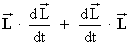 = 2L
= 2L
⇒ .
. = 2L
= 2L
But since, ⏊
⏊  ∴ .
∴ . = 0
= 0
Therefore, from eq (i) = 0
= 0
or magnitude of i.e., L does not change with time.
(b) So far we are confirm about two points
(1) or
or  ⏊
⏊  and
and
(2) = L is not changeing with time, therefore, it is a case when direction og
  is changing but its magnitude is constant and
  is perpendicular to
  at all points. Theis can be written as
If
Here, a = positive constan
i.e., This relation implies that
is perpendicular to both and .Therefore, option (a) is correct.
(c) Here,
Differentiating w.r.t time, we get
= 2L⇒
. = 2L But since,
⏊ ∴ . = 0 Therefore, from eq (i)
= 0or magnitude of
i.e., L does not change with time.(b) So far we are confirm about two points
(1)
or ⏊ and(2)
= L is not changeing with time, therefore, it is a case when direction og is changing but its magnitude is constant and is perpendicular to at all points. Theis can be written asIf
Here, a = positive constan
Create a free account to view solution
View Solution FreeMore Rotational Motion Questions
A body of mass m slides down an incline and reaches the bottom with a velocity v. If the same mass were in the form of a...If earth shrinks to half of its diameter keeping mass constant then the duration of the day will be :-...A circular plateform is free to rotates in a horizontal plane about a vertical axis passing through its centre. A tortoi...A string is wrapped around the rim of a wheel of moment of inertia 0.20 kg-m2 and radius 20 cm. The wheel is free to rot...Three thin rods each of length L and mass M are placed along X, Y and Z-axes in such a way that one end of each of the r...