Circular MotionEasy
Question
A long horizontal rod has a bead which can slide along its length and is initially placed at a distance L from one end A of the rod. The rod is set in angular motion about A with a constant angular acceleration α. If the coefficient of friction between the rod and bead is μ, and gravity is negligible, then the time after which the bead starts slipping is
Options
A.
B.
C.
D.infinitesimal
Solution
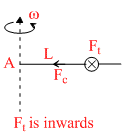
Tangential force (Ft) of the bead will be given by the normal reaction (N), while centripetal force (Fc) is provided by friction (fr). The bead starting sliding when the centripetal force is just equal to the limiting friction.
Therefore, Ft = ma = mαL = N
∴ Limiting value of friction
(fr)max = μ N = μmαL ....(i)
Angular velocity at time t is ω = αt
∴ Centripetal force at time t will be
Fc = mLωt2 = mLα2t2 ....(ii)
Equating eqs (i) and (ii), we get
t =

For t >
, Fc > (fr)max i.e., the bead stats sliding.In the figure Fc is perpendicular to the paper inwards.
Create a free account to view solution
View Solution FreeMore Circular Motion Questions
In the shown figure inside a fixed hollow cylinder with vertical axis a pendulum is moving conically with its axis same ...A small block slides with velocity 0.5 on the horizontal frictionless surface as shown in the Figure. The block leaves t...In the above question . is zero for:...A stone of mass of 16 kg is attached to a string 144 m long and is whirled in a horizontal smooth surface. The maximum t...A bucket is whirled in a vertical circle with a string attached to it.The water in bucket does not fall down even when t...