KinematicsEasy
Question
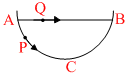
A particle P is sliding down a frictionless hemispherical bowl. It passes the point A at t = 0. At this instant of time, the horizontal component of its velocity is v. A bead Q of the same mass as P is ejected from A at t = 0 along the horizontal string AB, with the speed v. Ffriction between the bead and the string may be neglected. Let tp and tq be respective time taken by P and Q to reach the point B. Then
Options
A.tp < tQ
B.tp = tQ
C.tp > tQ
D.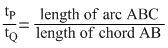
Solution
For particle P, motion between AC will be an accelerated one while between CB a retarded one. But in any case horizontal component of its velocity will be greater than or equal to v. On the other hand, in case of particle Q, it is always equal to v. Horizontal displacement for both the particles are equal. Therefore, tp < tq.
Create a free account to view solution
View Solution FreeMore Kinematics Questions
A particle leaves the origin an initial velocity = 3 m/s and a constant acceleration = (-1.0î - 0.5ĵ) m/s2 Its...A particle has an initial velocity and an acceleration of . Its speed after 10 s is...A particle is projected from a point on the ground with an initial velocity of u = 50 m/s at an angle of 53o with the ho...A ball is thrown upwards. Its height varies with times as follows : If the accelertion due to gravity is 7.5 m / s2 then...A particle P is projected from a point on the surface of smooth inclined plane (see figure). Simultaneously another part...