ElectrochemistryMedium
Question
The reaction,  H2(g) + AgCl(s) → H+ (aq) + Cl- (aq) + Ag(s) occurs in the galvanic cell :
H2(g) + AgCl(s) → H+ (aq) + Cl- (aq) + Ag(s) occurs in the galvanic cell :Options
A.Ag | AgCl(s)| KCl(soln) || AgNO3 | Ag
B.Pt | H2 (g) | HCl(soln) || AgNO3(soln) | Ag
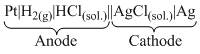
C.Pt | H2 (g) | HCl(soln) || AgCl(s) | Ag
D.Pt | H2 (g) | KCl(soln) || AgCl(s) | Ag
Solution
In this cell H2 is oxidised to H+ and acts as anode while Ag+ is reduced to Ag. The cell may be represented as
Create a free account to view solution
View Solution FreeMore Electrochemistry Questions
The ionic mobility of alkali metal ions in aqueous solution is maximum for...The solubility product of silver iodide is 8.3 × 10⁻¹⁷ and the standard reduction potential of Ag, Ag+ electrode is...In which of the following cell (s) : Ecell = Eocell ?...Cost of electricity for the production of ′X′ litre H2 at NTP at cathode is Rs. X, then cost of electricity ...The EMF of the cell: Zn|Zn2+ (0.01 M)||Fe2+ (0.001 M)|Fe at 298 K is 0.2905 V, then the value of equilibrium constant fo...