Coordination CompoundHard
Question
Which of the following complex will show optical activity ?
Options
A.trans -[Co(NH3)4Cl2]+
B. [Cr(H2O)6]3+
C.cis -[Co(NH3)2(en)2]3+
D.trans -[Co(NH3)2(en)2]3+
Solution
(A) trans-[Co(NH3)4Cl2]+ has plane of symmetry as well as centre of symmetry. Hence it does not show optical isomerism.
(B) [Cr(H2O)6]3+ has plane of symmetry as well as centre of symmetry. Hence it does not show optical isomerism.
(C) (C) cis-[Co(NH3)2(en)2]3+ lacks one of the symmetry elements.
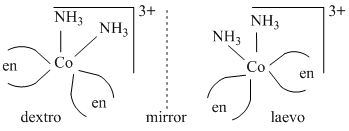
(D) trans-[Co(NH3)2(en)2]3+ has plane of symmetry as well as centre of symmetry. Hence it does not show optical isomerism.
(B) [Cr(H2O)6]3+ has plane of symmetry as well as centre of symmetry. Hence it does not show optical isomerism.
(C) (C) cis-[Co(NH3)2(en)2]3+ lacks one of the symmetry elements.
(D) trans-[Co(NH3)2(en)2]3+ has plane of symmetry as well as centre of symmetry. Hence it does not show optical isomerism.
Create a free account to view solution
View Solution FreeMore Coordination Compound Questions
The most stable ion is...Gun metal is:...The complex ion which has no d electrons in the central metal atom is (At No. Cr = 24, Mn = 25, Fe = 26 , Co = 27) :...Which of the following is a bidentate, unsymmaterical, anionic ligand :-...Complexes [Co(NH3)5SO4]Br and [Co(NH3)5Br]SO4 can be distinguished by :...