MetallurgyHard
Question
Consider the following isolation / purification processes.
(I) Heating impure metal with I2 at 150 - 200oC and passing the resulting volatile iodide on hot tungsten filament at 1400oC to get the pure metal.
(II) Heating the sulphide ore in air until a part is converted to oxide and then further heating in the absence of air to let the oxide react with unchanged metal sulphide to get the metal.
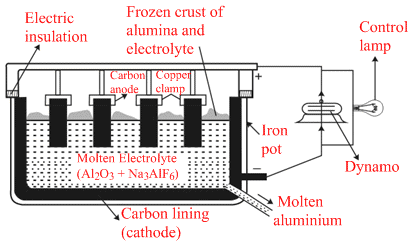
(III) Electrolysis of the molten electrolyte containing metal oxide and cryolite or florspar to obtain the metal.
The processes used for obtaining aluminium, titanium and lead are respectively :
Options
A.(I), (II) and (III)
B.(II), (III) and (I)
C.(III), (I) and (II)
D.(II), (I) and (III)
Solution
(I) Ti (s) (impure) + 2I2(g) 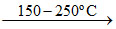 TiI4 (volatile)
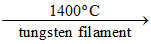 Ti (s) (pure) + 2I2 (g)
(II) 2PbS + 3O2 2PbO + 2SO2
PbS + 2PbO 3Pb + SO2
(III) Cathode : Al3+ (melt) + 3e- → Al (l)
Anode : C(s) + O2- (melt) → CO(g) + 2e-
C(s) + 2O2- (melt) → CO2 (g) + 4e-
TiI4 (volatile) Ti (s) (pure) + 2I2 (g)(II) 2PbS + 3O2
2PbO + 2SO2PbS + 2PbO
3Pb + SO2(III) Cathode : Al3+ (melt) + 3e- → Al (l)
Anode : C(s) + O2- (melt) → CO(g) + 2e-
C(s) + 2O2- (melt) → CO2 (g) + 4e-
Create a free account to view solution
View Solution FreeMore Metallurgy Questions
Which method of purification is represented by the equations ?...Selection of temperature to carry out a reduction process depends so as to make :...Which of the following processes is used in extractive metallurgy of magnesium ?...Si and Ge used for semiconductors are required to be of high purity and hence purified by...The correct statements are:...