Photoelectric EffectMedium
Question
A source S1 is producing, 1015 photons per second of wavelength 5000  . Another source S2 is producing 1.2 × 10¹⁵ photons per second of wavelength 5100 . Then,(power of S2)/(power of S1) is equal to
. Another source S2 is producing 1.2 × 10¹⁵ photons per second of wavelength 5100 . Then,(power of S2)/(power of S1) is equal toOptions
A.1.00
B.1.02
C.1.04
D.0.98
Solution
For a source S1
Wavelength, λ1 = 5000
Number of photons emitted per second, N1 = 1015
Energy of each photon, E1 =
Power of source S1, P1 = E1N1

For a source S2
Wavelength, λ2 = 5100
Number of photons emitted per second, N2 = 1.02 × 10¹⁵
Energy of each photon, E2 =
Power of source S2, P2 = E2N2
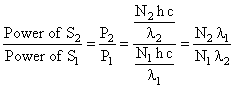
∴
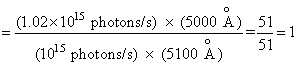
Wavelength, λ1 = 5000
Number of photons emitted per second, N1 = 1015
Energy of each photon, E1 =
Power of source S1, P1 = E1N1
For a source S2
Wavelength, λ2 = 5100
Number of photons emitted per second, N2 = 1.02 × 10¹⁵
Energy of each photon, E2 =
Power of source S2, P2 = E2N2
∴
Create a free account to view solution
View Solution FreeMore Photoelectric Effect Questions
A small particle of mass 10-13 kg and velocity 10 cm/s then associated wavelength will be :...Photon of energy 6 eV is incident on a metal surface of work function 4 eV. Maximum KE of emitted photo electrons will b...Let K1 be the maximum kinetic energy of photoelectrons emitted by a light of wavelength λ1 and K2 corresponding to ...When photo energy 4.25 eV strike the surface of a metal A, the ejected photoelectrons have maximum kinetic energy TA exp...The work function of a photo electric material is 3.3 eV. Its threshold frequency will be :...