Gaseous StateHard
Question
Two flasks of equal volume are connected by a narrow tube (of negligible volume) all at 27oC and contain 0.70 moles of H2 at 0.5 atm. One of the flask is then immersed into a bath kept at 127oC, while the other remains at 27oC. The number of moles of H2 in flask 1 and flask 2 are :
Options
A.Moles in flask 1 = 0.4, Moles in flask 2 = 0.3
B.Moles in flask 1 = 0.2, Moles in flask 2 = 0.3
C.Moles in flask 1 = 0.3, Moles in flask 2 = 0.2
D.Moles in flask 1 = 0.4, Moles in flask 2 = 0.2
Solution
Let vol. of each flask is ′V′ L, Initially
0.5 × 2V = 0.7 × 0.0821 × 300
V = 17.24 L
Let T is final temperature of flask when pressure in each flask becomes equal, it happens. when
nTotal = n1 + n2
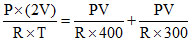 ⇒
⇒ 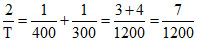
T = = 342.85 K
P × 2 × 17.24 = n1 × 0.0821 × 400 ⇒ n1 = 0.3
0.5714 × 17.24 = n2 × 0.0821 × 300 ⇒ n2 = 0.4
0.5 × 2V = 0.7 × 0.0821 × 300
V = 17.24 L
Let T is final temperature of flask when pressure in each flask becomes equal, it happens. when
nTotal = n1 + n2
⇒ T =
= 342.85 KP × 2 × 17.24 = n1 × 0.0821 × 400 ⇒ n1 = 0.3
0.5714 × 17.24 = n2 × 0.0821 × 300 ⇒ n2 = 0.4
Create a free account to view solution
View Solution FreeMore Gaseous State Questions
Consider given reaction : Metal (M) Select correct statement(s)...The product of PV is plotted against P at two temperatures T1 and T2 and the ′result is shown in figure. What is c...Chemical temperature for A, B, C and D gases are 25oC, 10oC, -80oC and 15oC respectively. which gas will be liquefied mo...When a gas is compressed at constant temperature :...Equal weights of methane and hydrogen are mixed in an empty container at 25oc. The fraction of the total pressure exerte...