Coordination CompoundHard
Question
Which of the following complex ions is not expected to absorb visible light ?
Options
A.[Ni(CN)4]2-
B.[Cr(NH3)6]3+
C.[Fe(H2O)6]2+
D.[Ni(H2O)6]2+
Solution
For the absorption of visible light, presence of unpaired d-electrons is the necessity.
(a) In [Ni(CN)4]2-, Ni is present as Ni2+.
Ni2+ = [Ar] 3d8 4s0
∴ [Ni(CN)4]2- =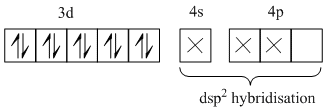
(Pairing occurs because CN is a strong field ligand).
Since, in [Ni(CN)4]2-, no unpaired electron is present in d-orbitals, it does not absorb visible light.
(b) In [Cr(NH3)6]3+, Cr is present as Cr3+ .
Cr3+ = [Ar]3d3 4s0 (Three unpaired electrons)
(c) In [Fe(H2O)6]2+, Fe is present as Fe2+.
Fe2+ = [Ar]3d6 4s0 (Four unpaired electrons)
(d) In [Ni (H2O)6]2+, Ni is present as Ni2+.
Ni2+ = [Ar] 3d8 4s0 (Two unpaired electrons)
The complexes given in option (b), (c), (d) have unpaired electrons, thus absorb visible light.
(a) In [Ni(CN)4]2-, Ni is present as Ni2+.
Ni2+ = [Ar] 3d8 4s0
∴ [Ni(CN)4]2- =
(Pairing occurs because CN is a strong field ligand).
Since, in [Ni(CN)4]2-, no unpaired electron is present in d-orbitals, it does not absorb visible light.
(b) In [Cr(NH3)6]3+, Cr is present as Cr3+ .
Cr3+ = [Ar]3d3 4s0 (Three unpaired electrons)
(c) In [Fe(H2O)6]2+, Fe is present as Fe2+.
Fe2+ = [Ar]3d6 4s0 (Four unpaired electrons)
(d) In [Ni (H2O)6]2+, Ni is present as Ni2+.
Ni2+ = [Ar] 3d8 4s0 (Two unpaired electrons)
The complexes given in option (b), (c), (d) have unpaired electrons, thus absorb visible light.
Create a free account to view solution
View Solution FreeMore Coordination Compound Questions
Consider the following statements:According the Werner′s theory.(1) Ligands are connected to the metal ions by ion...Nickel (Z = 28) combines with a uninegative monodentate ligand X- to form a paramagnetic complex [NiX4]2-. The number of...The number of donor sites in dimethyl glyoxime, glycinato, diethylene triamine and EDTA are respectively:...[Cr(H2O)6]Cl3 (atomic number of Cr = 24) has a magnetic moment of 3.83 B.M. The correct distribution of 3d electrons in ...Which of the following statements is incorrect?...