Trigonometric EquationEasy
Question
Two adjacent sides of a parallelogram ABCD are given by 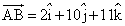 and
and 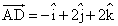 . The side AD is rotated by an acute angle α in the plane of the parallelogram so that AD becomes AD′. If AD′ makes a right angle with the side AB, then the cosine of the angle α is given by
and . The side AD is rotated by an acute angle α in the plane of the parallelogram so that AD becomes AD′. If AD′ makes a right angle with the side AB, then the cosine of the angle α is given byOptions
A.
B.
C.
D.
 ⇒ cos α =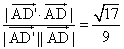
More Trigonometric Equation Questions
If 2 tan2θ = sec2θ, then the general value of θ is -...The value of θ satisfying 3cos2 θ − 2√3 sin θ cos θ − 3 sin2 θ = 0 are-...If (g(t))2 + C, where C is a constant, then g(2) is equal to :...If = 3 then the general solution of θ is-...Let P = (-1, 0), Q = (0, 0) and R = (3, 3√3) be three points. The equation of the bisector of the angle PQR...