ElectrochemistryHard
Question
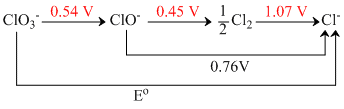
The Eo in the given figure is,
Options
A.0.5
B.0.6
C.0.7
D.0.8
Solution
ClO3- + 2H2O + 4e → ClO- + 4OH- ; ᐃG1o
ClO- + H2O + e → Cl2 + 2OH- ; ᐃG2o
Cl2 + e → Cl- ; ᐃG3o
__________________________________
ClO3- + 3H2O + 3e → Cl- + 6OH- ; ᐃGo
__________________________________
∴ ᐃGo = ᐃG1o + ᐃG2o + ᐃG3o
- 6FEo = - 4F × 0.54 - 1F × 0.45 - 1F × 1.07
Eo = + = + 0.61 V
ClO- + H2O + e →
Cl2 + 2OH- ; ᐃG2oCl2 + e → Cl- ; ᐃG3o__________________________________
ClO3- + 3H2O + 3e → Cl- + 6OH- ; ᐃGo
__________________________________
∴ ᐃGo = ᐃG1o + ᐃG2o + ᐃG3o
- 6FEo = - 4F × 0.54 - 1F × 0.45 - 1F × 1.07
Eo = +
= + 0.61 VCreate a free account to view solution
View Solution FreeMore Electrochemistry Questions
The copper anode of a cell containing silver nitrate solution weighs 60.0 g. After passing current for some time, it is ...A hydrogen electrode placed in a buffer solution of CH3COONa and CH3COOH in the ratio’s x:y and y:x has electrode potent...A hydrogen gas electrode is made by dipping platinum wire in a solution of HCl of pH = 10 and by passing hydrogen gas ar...Given the ionic equivalent conductivities for the following ions: λoeq K+ = 73.5 cm2 ohm-1 eq-1 λoeq Al3+ = 14...Consider the cell potentials EoMg2+|Mg = - 2.37 V and EoFe3+|Fe = - 0.04 V. The best reducing agent would be...