Set, Relation and FunctionEasy
Question
Let f be a real-valued function defined on the interval (0, ∞) by f(x) = ln x +  . Then which ofthe following statement(s) is (are) true?
. Then which ofthe following statement(s) is (are) true?Options
A.f″(x) exists for all x ∈ (0, ∞)
B.f′(x) exists for all x ∈ (0, ∞) and f′ is continuous on (0, ∞) but not differentiable on (0, ∞)
C.there exists α > 1 such that |f′(x)| < |f(x)| for all x ∈ (α, ∞)
D.there exists β > 0 such that |f(x)| + |f′(x)| ≤ β for all x ∈ (0, ∞)
Solution
f′(x) = 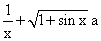
f′(x) is not differentiable at sinx = −1 or x = 2nπ - n ∈ N
n ∈ N
In x ∈ (1, ∞) f(x) > 0, f′(x) > 0
Consider f(x) - f′(x)
= ln x +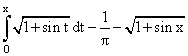
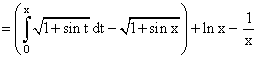
Consider g(x) =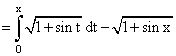
It can be proved that g(x) ≥ 2√2 - √10 ∀ x ∈ (0, ∞)
Now there exists some α > 1 such that - ln x ≤ 2√2 - √10 for all x ∈ (α, ∞) as - ln x is strictly decreasing function.
⇒ g(x) ≥ - ln x.
f′(x) is not differentiable at sinx = −1 or x = 2nπ -
n ∈ NIn x ∈ (1, ∞) f(x) > 0, f′(x) > 0
Consider f(x) - f′(x)
= ln x +
Consider g(x) =
It can be proved that g(x) ≥ 2√2 - √10 ∀ x ∈ (0, ∞)
Now there exists some α > 1 such that
- ln x ≤ 2√2 - √10 for all x ∈ (α, ∞) as - ln x is strictly decreasing function.⇒ g(x) ≥
- ln x.Create a free account to view solution
View Solution FreeMore Set, Relation and Function Questions
If Na = {an : n ∈ N}, then =...If A denotes the area between the curve 2{y} = [x] + 1 for 0 ≤ y 2 - x ≤ 0, then A is less than or equal to ...Let R be a relation on the set N of natural numbers defined by nRm ⇔ n is a factor of m (i.e. n | m). Then R is -...Given ∫ dx = C(where C is integration constant). If k1, k2 are two values of k satisfying above relation, where k1...For two data sets, each of size 5, the variances are given to be 4 and 5 and the corresponding means are given to be 2 a...