Quadratic EquationEasy
Question
Let p and q be real numbers such that p ≠ 0, P3 ≠ -q. If α and β are nonzero complex numbers satisfying α + β = - p and α3 + β3 = q. then a quadratic equation having  and
and  as its roots is
and as its roots isOptions
A.(p3 + q)x2 - (p3 + 2q)x + (p3 + q) = 0
B.(p3 + q)x2 - (p3 - 2q)x + (p3 + q) = 0
C.(p3 - q)x2 - (5p3 - 2q)x + (p3 - q) = 0
D.(p3 - q)x2 - (5p3 + 2q)x + (p3 - q) = 0
Solution
α3 + β3 = q
⇒ (α + β)3 - 3αβ (α + β) = q
⇒ - p3 + 3pαβ = q ⇒ αβ =
x2 -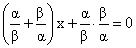
x2 - x + 1 = 0
⇒ x2 -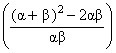 x + 1 = 0
⇒ x2 -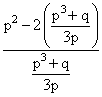 x + 1 = 0
⇒ (p3 + q) x2 - (3p3 - 2p3 - 2q) x + (p3 + q) = 0
⇒ (p3 + q) x2 - (p3 - 2q) x + (p3 + q) = 0.
⇒ (α + β)3 - 3αβ (α + β) = q
⇒ - p3 + 3pαβ = q ⇒ αβ =
x2 -
x2 -
x + 1 = 0⇒ x2 -
x + 1 = 0⇒ x2 -
x + 1 = 0 ⇒ (p3 + q) x2 - (3p3 - 2p3 - 2q) x + (p3 + q) = 0
⇒ (p3 + q) x2 - (p3 - 2q) x + (p3 + q) = 0.
Create a free account to view solution
View Solution FreeMore Quadratic Equation Questions
If a + b + c = 0, then the quadratic equation 3ax2 + 2bx + c = 0has...If 2a + 3b + 6c = 0 (a,b,c ∈ R) then the quadratic equation ax2 + bx + c = 0 has...Let S be the set of all non-zero numbers a such that the quadratic equation αx2 − x + a = 0 has two distinct ...The complete set of real values of 'a' for which there are distinct real numbers $x,y$ satisfying the equations $x = a -...Let $axx^{2} + bx + c$ is integer for all integral values of x , then which of the following must be true ?...