Set, Relation and FunctionEasy
Question
Let p(x) be a function defined on R such that p′(x) = p′(1 - x), for all x ∈ [0, 1], p(0) = 1 and p(1) = 41. Then  dx equals
dx equalsOptions
A.21
B.41
C.42
D.
Solution
p′(x) = p′(1 - x)
⇒ p(x) = - p(1 - x) + c
at x = 0
p(0) = - p (1) + c ⇒ 42 = c
now p(x) = - p(1 - x) + 42
⇒ p(x) + p(1 - x) = 42
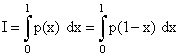
2I = ⇒ I = 21
⇒ p(x) = - p(1 - x) + c
at x = 0
p(0) = - p (1) + c ⇒ 42 = c
now p(x) = - p(1 - x) + 42
⇒ p(x) + p(1 - x) = 42
2I =
⇒ I = 21Create a free account to view solution
View Solution FreeMore Set, Relation and Function Questions
A natural number is selected at random from the set 1 ≤ x ≤ 100. The probability that the number satisfy the...If f(x) = ax + b (a < 0) is an onto function defined as f : [0, 1] → [0, 2], then cot is equal to...The minimum number of elements that must be added to the relation R = {(1, 2), (2, 3)} on the set {1,2,3}, so that it is...If A = {2, 3} and B = {1, 2}, then A × B is equal to -...The function f : [0, 3] → [1, 29], defined by f(x) = 2x3 - 15x2 + 36x + 1, is...