Work, Power and EnergyHard
Question
The potential energy function for the force between two atoms in a diatomic molecule is approximately given by U(x) =  where a and b are constants and x is the distance between the atoms. If the dissociation energy of the molecule is D = [U(x = ∞) - Uat equilibrium], D is
Options
A.
B.
C.
D.
Solution
U(x) = 
U(x = ∞) = 0
as,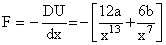
at equilibrium, F = 0
∴
∴ Uat equilibrium =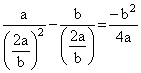
∴ D = [U(x = ∞) - Uat equilibrium] =
U(x = ∞) = 0
as,
at equilibrium, F = 0
∴
∴ Uat equilibrium =
∴ D = [U(x = ∞) - Uat equilibrium] =
Create a free account to view solution
View Solution FreeMore Work, Power and Energy Questions
A frictionless track ABCDE ends in a circular loop of radius R. A body slides down the track from point A which is at a ...A particle of mass $M$ moves along a horizontal $x$ axis from $x = 0$ to $x = L$. The coefficient of kinetic friction va...A body of mass 10 kg is released from a Tower of height 20m and body acquires a velocity of 10 ms-1 after falling throug...A block of mass 10 kg is moving in x-direction with a constant speed of 10m/sec it is subjected to a retarding force F= ...A force acts on a 3 gm particle in such a way that the position of the particle as a function of time is given by x = 3t...