ProbabilityMedium
Question
If A & B are two events such the P(B) ≠ 1, Bc denotes the event complementary to B, then -
Options
A.P(A/Bc) = 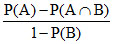
B.P(A ∩ B) ≥ P(A) + P(B) - 1
C.P(A) > < P(A/B) according as P(A/Bc) > < P(A)
D.P(A/Bc) + P(Ac/Bc) = 1
Solution
P(B) ≠ 1
(A)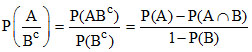
(B) 1 ≥ P(A υ B) = P(A) + P(B) - P(A ∩ B)
P(A ∩ B) ≥ P(A) + P(B) - 1
(D) P
=
= = 1
= 1
(A)
(B) 1 ≥ P(A υ B) = P(A) + P(B) - P(A ∩ B)
P(A ∩ B) ≥ P(A) + P(B) - 1
(D) P
=
=
= 1Create a free account to view solution
View Solution FreeMore Probability Questions
If the integers m and n are chosen at random between 1 and 100, then the probability that a number of the form 7m + 7n i...A fair coin is tossed a fixed number of times. If the probability of getting 7 heads is equal to that of getting 9 heads...If a, b and c are three numbers (not necessarily different) chosen randomly and with replacement from the set {1, 2, 3, ...A number is chosen at random from the numbers 10 to 99. By seeing the number a man will laugh if product of digits is 12...If A and B are two events, then P (neither A nor B) equals-...