Continuity and DifferentiabilityMedium
Question
f (x) = (sin-1 x)2 . cos (1/x) if x ≠ 0, f(0) = 0, f(x) is ;
Options
A.continuous no where in -1 ≤ x ≤ 1
B.continuous every where in -1 ≤ x ≤ 1
C.differentiable no where in - 1 ≤ x ≤ 1
D.differentiable everywhere -1 < x < 1
Solution
Since sin-1 x and cos  are continuous & differentiable in x ∈ [- 1, 1] - {0}
Now at x = 0
f′(0-) =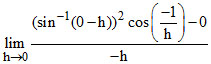 = 0
= 0
f′(0+) =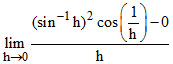 = 0
= 0
Hence LHD = RHD
so f(x) is continuous & differentiable every where
are continuous & differentiable in x ∈ [- 1, 1] - {0}Now at x = 0
f′(0-) =
= 0f′(0+) =
= 0Hence LHD = RHD
so f(x) is continuous & differentiable every where
Create a free account to view solution
View Solution Free