MonotonicityMedium
Question
If a < 0, the function f(x) = eax + e-ax is monotonically decreasing for all values of x, where-
Options
A.x > 0
B.x < 0
C.x > 1
D.x < 1
Solution
f(x) = eax + e-ax
⇒ f′(x) = a [eax - e-ax]
= 2a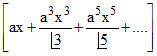
= 2a2x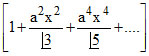
Now f′(x) < 0 ⇒ x < 0
Hence, f(x) is decreasing for x < 0.
f(x) = eax + e-ax
⇒ f′(x) = a [eax - e-ax]
= 2a
= 2a2x
Now f′(x) < 0 ⇒ x < 0
Hence, f(x) is decreasing for x < 0.
⇒ f′(x) = a [eax - e-ax]
= 2a
= 2a2x
Now f′(x) < 0 ⇒ x < 0
Hence, f(x) is decreasing for x < 0.
f(x) = eax + e-ax
⇒ f′(x) = a [eax - e-ax]
= 2a
= 2a2x
Now f′(x) < 0 ⇒ x < 0
Hence, f(x) is decreasing for x < 0.
Create a free account to view solution
View Solution FreeMore Monotonicity Questions
For what value of ′a′ the function f(x) = x + cos x − a increases...Function f(x) = log x is monotonic increasing when-...If the function f(x) = 2x2 + 5 satisfies LMVT at x = 2 on the closed interval [1, a] then the value of ′a′ i...Function f(x) = 2x2 − log x is increasing when...Function f(x) = 3x4 + 7x2 + 3 is...