DeterminantMedium
Question
If ᐃ1 =  and ᐃ2 =
  are given, then-
and ᐃ2 = are given, then- Options
A.ᐃ1 = 3(ᐃ2)2
B. ᐃ1 = 3ᐃ2
ᐃ1 = 3ᐃ2C.ᐃ1 = 3(ᐃ2)2
ᐃ1 = 3(ᐃ2)2D.ᐃ1 = 3(ᐃ2)3/2
Solution
ᐃ1 =  ᐃ2 =
ᐃ2 = 
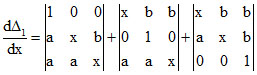
[1(x2 - ab) ] + [x(x - 0) - b(0 - 0) + b(0 - a)] + [(x(x - 0) - b(a - 0) + b(0)]
x2 - ab + x2 - ab + x2 - ab
3x2 - 3ab = 3(x2 - ab) = 3 ᐃ2
but ᐃ2 = = x(x) - ab
ᐃ2 = (x2 - ab)
ᐃ2 = [1(x2 - ab) ] + [x(x - 0) - b(0 - 0) + b(0 - a)] + [(x(x - 0) - b(a - 0) + b(0)]
x2 - ab + x2 - ab + x2 - ab
3x2 - 3ab = 3(x2 - ab) = 3 ᐃ2
but ᐃ2 =
= x(x) - abᐃ2 = (x2 - ab)
Create a free account to view solution
View Solution FreeMore Determinant Questions
The system of equation - 2x + y + z = 1, x - 2y + z = -2, x + y + λz = 4 will have no solution if...If a ≠ b ≠ c and = 0 then -...Let r = 1, 2, 3 be three mutually perpendicular unit vectors, then the value of is equal to...Find number of all possible ordered sets of two (n × n) matrices A and B for which AB - BA = I...The value of the determinant is -...