Continuity and DifferentiabilityHard
Question
If f(x) = | x - a | + | x + b |, x ∈ R, b > a > 0. Then -
Options
A.f′(a+) = 1
B.f′(a+) = 0
C.f′(- b+) = 0
D.f′(- b+) = 1
Solution
f(x) = | x - a | + | x + b | x | x ∈ R b > a > 0 then
f(x) = | x - a | + | x + b | b > a > 0
Let a = 1, b = 2 and 2 > 1 > 0
so f(x) = | x - 1 | + | x + 2 |
f(x) =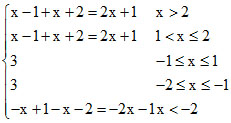
f(x) =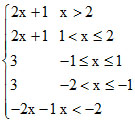
f′(x) =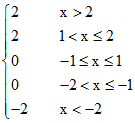
so that correct answer is f′(-b+) = 0
b = 2 f′(-2+) = 0
f(x) = | x - a | + | x + b | b > a > 0
Let a = 1, b = 2 and 2 > 1 > 0
so f(x) = | x - 1 | + | x + 2 |
f(x) =
f(x) =
f′(x) =
so that correct answer is f′(-b+) = 0
b = 2 f′(-2+) = 0
Create a free account to view solution
View Solution FreeMore Continuity and Differentiability Questions
If y = sin−1 + sec−1 , then dy/dx equals-...If f(x) = , x ≠ π / 4 is every where continuous, then f(π / 4) equals-...Let $f(x)$ and $g(x)$ be twice differentiable functions satisfying $f^{''}(x) = g^{''}(x)$ for all $x \i...If g is inverse of f and f(x) = x2 + 3x - 3 (x > 0) then g′(1) equals -...Function f(x) = is discontinuous at -...