Application of DerivativeMedium
Question
Which of the following pair(s) of curves is/are orthogonal.
Options
A.y2 = 4ax ; y = e-x/2a
B.y2 = 4ax; x2 = 4ay
C.xy = a2; x2 - y2 = b2
D.y = ax; x2 + y2 = c2
Solution
(a) 2y = 4a ⇒
 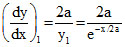 = m1
= m1
For IInd curve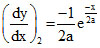 = m2
= m2
m1m2 = - 1
(b) 2y = 4a; 2x = 4a
m1 = m2 =
m2 = 
y12 = 4ax1 ......(i) = 4ay1 ...... (ii)
m1m2 ≠ - 1
(c) y = ; x2 - y2 = b2
m1 = - ; 2x1 - 2y1m2 = 0 ⇒ m2 =
m1m2 = = - 1
= - 1
(d) m1 = = a ; 2x + 2ym2 = 0
m2 = -
m1m2 = = -1
= -1
= 4a ⇒ = m1For IInd curve
= m2m1m2 = - 1
(b) 2y
= 4a; 2x = 4a m1 =
m2 = y12 = 4ax1 ......(i)
= 4ay1 ...... (ii)m1m2 ≠ - 1
(c) y =
; x2 - y2 = b2m1 = -
; 2x1 - 2y1m2 = 0 ⇒ m2 = m1m2 =
= - 1(d) m1 =
= a ; 2x + 2ym2 = 0m2 = -
m1m2 =
= -1Create a free account to view solution
View Solution FreeMore Application of Derivative Questions
The point (s) on the curve y3 + 3x2 = 12y where the tangent is vertical, is (are)...The coordinates of the point on the curve y = x2 + 3x + 4 the tangent at which passes through the origin are-...The length of the sub tangent to the curve √x + √y = 3 at the point (4, 1) is-...Water is dripping out from a conical funnel of semi-vertical angle at the uniform rate of 2 cm3/sec in its surface area ...At what point the slope of the tangent to the curve x2 + y2 - 2x - 3 = 0 is zero -...