Application of DerivativeMedium
Question
If 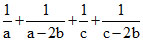 = 0 and a, b, c are not in A.P., then -
= 0 and a, b, c are not in A.P., then -Options
A.a, b, c are in G.P.
B.a, b/2, c are in A.P.
C.a, b/2, c are in H.P.
D.a, 2b, c are in H.P.
Solution
Given 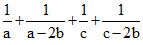 = 0
= 0
⇒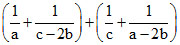 = 0
= 0
⇒ (a + c - 2b)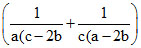 = 0
= 0
As a + c - 2b ≠ 0
⇒
i.e. a, 2b, c are in H.P.
= 0⇒
= 0⇒ (a + c - 2b)
= 0As a + c - 2b ≠ 0
⇒
i.e. a, 2b, c are in H.P.
Create a free account to view solution
View Solution FreeMore Application of Derivative Questions
The side of a square sheet is increasing at the rate of 4 cm per minute. The rate by which the area increasing when the ...Let f and g be increasing and decresing functions respectively from [0, ∞) to [0, ∞) Let h(x) = f (g(x)). If...The point on the curve y = x2 − 3x + 2 at which the tangent is perpendicular to the line y = x is-...If f′(x) = |x| - {x}, where {x} denotes the fractional part of x, then f(x) is decreasing in :-...The value of c for the function f(x) = log sin x in the interval is-...