Geometrical OpticsHard
Question
The plane faces of two identical plano-convex lenses, each having a focal length of 50 cm are placed against each other to form a usual biconvex lens. The distance from this lens combination at which an object must be placed to obtain a real, inverted image which has the same size as the object is :-
Options
A.25 cm
B.40 cm
C.50 cm
D.100 cm
Solution
On joining the plane surfaces of two identical plano-convex lenses the biconvex lens so formed has focal length
 = (μ - 1)
where, R2 = - R1 = R
or .....(i)
For each plano-convex lens,
 = (μ - 1)
 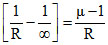 .....(ii)
From eqs. (i) & (ii), we get
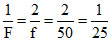
or F = 25 cm
For obtaining a real, inverted image of the object size, the object must be placed at a distance
R = 2F = 2 × 25 = 50 cm
= (μ - 1)where, R2 = - R1 = R
or
.....(i)For each plano-convex lens,
= (μ - 1) .....(ii)From eqs. (i) & (ii), we get
or F = 25 cm
For obtaining a real, inverted image of the object size, the object must be placed at a distance
R = 2F = 2 × 25 = 50 cm
Create a free account to view solution
View Solution FreeMore Geometrical Optics Questions
The critical angle of a medium with respect to air is 45o. The refractive index of medium is :-...Thin convex lens made from crown glass has focal length f. When it is measured in two different liquids having refractiv...How can the chromatic abrration be corrected :...To get three images of a single object, one should have two plane mirrors at an angle of...The figure shown a ray incident on a plane boundary at an angle i = π/3.The plot drawn shows the variation of | r -...