Maxima and MinimaEasy
Question
If f(x) =  (t - 2)(t - 3) dt for all x ∈ (0, ∞), then
(t - 2)(t - 3) dt for all x ∈ (0, ∞), thenOptions
A.f has a local maximum at x = 2
B.f is decreasing on (2, 3)
C.there exists some c ∈ (0, ∞) such that f″(c) = 0
D.f has a local minimum at x = 3
Solution
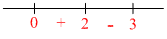
f′(x) = ex2 (x - 2)(x - 3)
Clearly, maxima at x = 2, minima at x = 3 and
decreasing in x ∈ (2, 3).
f′(x) = 0 for x = 2 and x = 3
so there exist c ∈(2, 3) for which
f′′(x)
Create a free account to view solution
View Solution FreeMore Maxima and Minima Questions
If the function f(x) = 2x3 - 9ax2 + 12a2 x + 1, where a > 0, attains its maximum and minimum at p and q respectively suc...The sum of two number is 12. If their product is maximum, then they are -...The function f(x) = assumes minimum value for x given by...f : → R, If f(x) = loge ((sin x)sinx + 1), then the minimum value of f(x) is :...Determine the largest area of the rectangle whose base is on the x-axis and two of its vertices lie on the curve y = e-x...