Quadratic EquationEasy
Question
Let α (a) and β (a) be the roots of the equation  where a > - 1. Then
  α(a) and β(a) are
where a > - 1. Then α(a) and β(a) are Options
A. and 1
and 1
and 1B. and - 1
and - 1C. and 2
and 2
and 2D. and 3
and 3
and 3Solution
Let 1 + a = y
⇒ (y1/3 - 1) x2 + (y1/2 - 1)x + y1/6 - 1 = 0
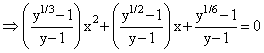
Now taking on both the sides
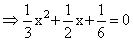
⇒ 2x2 + 3x + 1 = 0
x = - 1, -
⇒ (y1/3 - 1) x2 + (y1/2 - 1)x + y1/6 - 1 = 0
Now taking
on both the sides ⇒ 2x2 + 3x + 1 = 0
x = - 1, -
Create a free account to view solution
View Solution FreeMore Quadratic Equation Questions
If $a,b,c$ are the roots of the cubic equation $x^{3} - 3{ax}^{2} + 3bx - c^{3} = 0$, then which of the following may be...If the value of quadratic trinomial $ax^{2} - bx + c$ is an integer for $x = 0,x = 1$ and $x = 2$, then the valueof the ...The equation = √2 has...Let the expression $\frac{(ax - b)(dx - c)}{(bx - a)(cx - d)}$ takes all real values when $x$ is real, $a,b,c,d$ are all...Sum of roots is −1 and sum of their reciprocals is , then equation is -...